The role of sandwich panels in industrial and prefabricated buildings
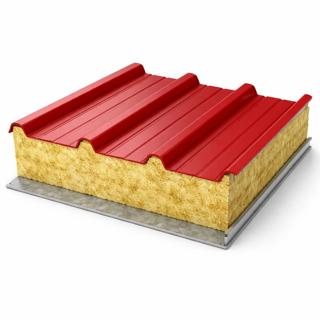
In industrial projects and prefabricated structures, three factors are always decisive: speed of execution, cost control and technical performance (insulation and durability). Sandwich panels shine precisely at this point; because instead of traditional wall and roof construction, they offer a ready-made and engineered system that is simultaneously lightweight, resistant and insulating. The result? Industrial buildings are put into operation faster, energy consumption is reduced and maintenance is simplified. 3D view of a roof sandwich panel with colored galvanized sheet and intermediate thermal insulation
 What is a sandwich panel and why is it important for industry?
A sandwich panel is a multilayer material that usually consists of:
- Two layers of metal sheet (galvanized/aluzinc/colored)
- and an insulating core (such as polyurethane, polystyrene or rock wool)
This structure provides a better strength-to-weight ratio and significant thermal/sound insulation compared to traditional materials; something that is vital for industrial environments (sheds, warehouses, cold stores, production halls).
To learn more about Sabat Sanat Shomal and learn about its production capacity and standards, click here.
The key role of sandwich panels in industrial buildings
1) Increasing the speed of implementation and reducing the time of capital dormancy
In an industrial project, every day of delay means cost. Sandwich panels, due to their prefabrication and modular installation, greatly reduce the time of implementation of the building shell (walls and roof).
This means:
Faster production line setup
Faster project delivery
Reduced workshop and manpower costs
2) Reducing the weight of the structure and optimizing the skeleton
One of the important advantages of sandwich panels in industrial sheds and applications is lightness. Lightening the shell:
Reduces dead load
Enables optimization of the dimensions of the steel frame
Improves the seismic behavior of the structure (in many scenarios)
3) Energy management in production halls, warehouses and workshops
In an industrial environment, energy loss is a direct cost. By creating a continuous insulation layer, sandwich panels:
Reduce heat/cold loss
Reduces the strain on HVAC systems
Creates more stable temperature conditions (important for the product and the production process)
4) Hygiene, cleaning and industrial standards
For the food, pharmaceutical, health industries and many warehouses, the surface of the walls and ceilings must be washable, with few seams and resistant to moisture and pollution. Sandwich panels (with the correct choice of sheet type and the principled execution of joints) cover this need better than traditional walls.
See Sabat Sanat Shomal's prefabricated health and medical structures here.
5) Control fire risk by choosing the right material
In industrial projects, safety is a serious issue. Part of the role of sandwich panels in industry comes down to choosing the right core. In sensitive spaces, it is usually important to consider options with better fire performance (such as some rock wool-based solutions).
Note: Fire performance is not limited to the core; installation, sealing and connection details are also decisive.
The role of sandwich panels in prefabricated buildings
A prefabricated building means producing a significant part of the building components in the form of ready-made and assembled systems. Sandwich panels in this construction model practically become a “standard shell”:
1) Standardization and quality control
When walls and ceilings are constructed with industrially produced panels with controlled specifications, quality uniformity increases, human error is minimized, and project time and cost predictability is significantly improved.
2) Possibility of disassembly, expansion, and relocation
In many workshop projects or project camps where changes in plan or expansion are inevitable, sandwich panels provide high flexibility due to their ability to open and close, rapid expansion of the building, and even the possibility of reuse in some scenarios.
3) Better performance in different climates
In prefabricated projects (villas, industrial cabins, workshop buildings), the climate is decisive. By choosing the appropriate thickness and type of insulation, sandwich panels can:
- Reduce heat loss in cold areas
- Reduce cooling load in hot and humid areas
- Manage the problem of sweating and humidity to a large extent (with proper implementation)
The most important applications of sandwich panels in industry and prefabricated
- Sheds and production halls
- Warehouses and logistics centers
- Cold storage and temperature-controlled rooms
- Workshops and construction projects (camps, workshop office buildings)
- Light sports and exhibition halls
- Industrial interior separating walls (insulated partitions)
Criteria for selecting sandwich panels for industrial and prefabricated projects
1) Type of use and environmental conditions of the project
The first step in selecting a sandwich panel is to accurately identify the operating conditions; Factors such as high humidity, corrosive environments (near the sea or chemical industries), the need for constant washing, as well as the temperature sensitivity of the process or product, directly affect the type of panel and the execution details.
2) Type and thickness of the intermediate insulation
The type and thickness of the insulation core (such as polyurethane, polystyrene or rock wool) plays a decisive role in reducing energy consumption, improving sound insulation and increasing the level of fire safety and must be selected according to the climate and use of the space.
3) Type of sheet and quality of paint coating
To ensure long-term durability and maintain the appearance of the structure, it is of particular importance to choose the correct sheet (galvanized, aluzinc or colored) and pay attention to the quality of the paint coating; especially in projects that are exposed to moisture, corrosive substances or intense sunlight.
4) Final installation and sealing details
Even the best sandwich panel will not perform optimally without proper implementation. The way the panels are overlapped and installed, choosing the right screws and flashings, using standard sealants, and properly implementing the substructure are among the most important factors that ensure the final quality of the project.
Click to read the article "Does sandwich panel installation training take a long time?"
Common mistakes in sandwich panel projects (and how to prevent them)
- Choosing thickness solely based on price → increases energy and repair costs.
- Neglecting flashing and sealing → water penetration, rust, and insulation loss.
- Lack of attention to climatic conditions (humidity/corrosion) → reduced life of the sheet and joints.
- Improper installation of screws (improper torque/poor washers) → leakage and damage to the shell.
Conclusion: Why is the sandwich panel the main pillar of industrial and prefabricated construction?
Sandwich panels in industrial and prefabricated buildings are not just “alternative materials”; they are a fast and engineered skinning system that simultaneously:
- Reduces project execution time
- Reduces the weight of the structure
- Optimizes energy consumption
- And simplifies maintenance and hygiene.
If the material selection and installation details are done correctly, sandwich panels can be one of the most economical and reliable options for industrial and modern projects.
To select the appropriate type of panel for industrial or prefabricated projects, including determining the thickness, type of insulation, sheet material and installation details, you can use Sabat Sanat’s specialized advice to control implementation costs, ensure insulation performance and long-term durability of the structure.
Frequently Asked Questions (FAQ)
1) Is sandwich panel better for a shed or traditional wall cladding?
In most industrial projects, sandwich panels are a better option due to their speed of implementation, insulation and lower weight; But the final decision depends on the application, budget and technical requirements (such as fire and climate conditions).
2) What is the most important factor in the final quality of panel structures?
In addition to the quality of the panel, proper installation, sealing, flushing and connections play the most role in durability and actual performance.
3) Can sandwich panels be developed for prefabricated buildings?
Yes, in many projects, with proper design, development or changes can be made faster; because it is an assembly system.
4) What thickness is suitable for reducing energy consumption in an industrial building?
It is better to choose the thickness based on the climate, application and target temperature. Choosing only based on guesswork or price usually creates hidden costs.